
How Word Searches Improve Vocabulary
Word searches are more than a relaxing activity. Discover how they help improve vocabulary, spelling, focus, memory, and word recognition for adults, seniors, students, and puzzle lovers.
7/2/20264 min read
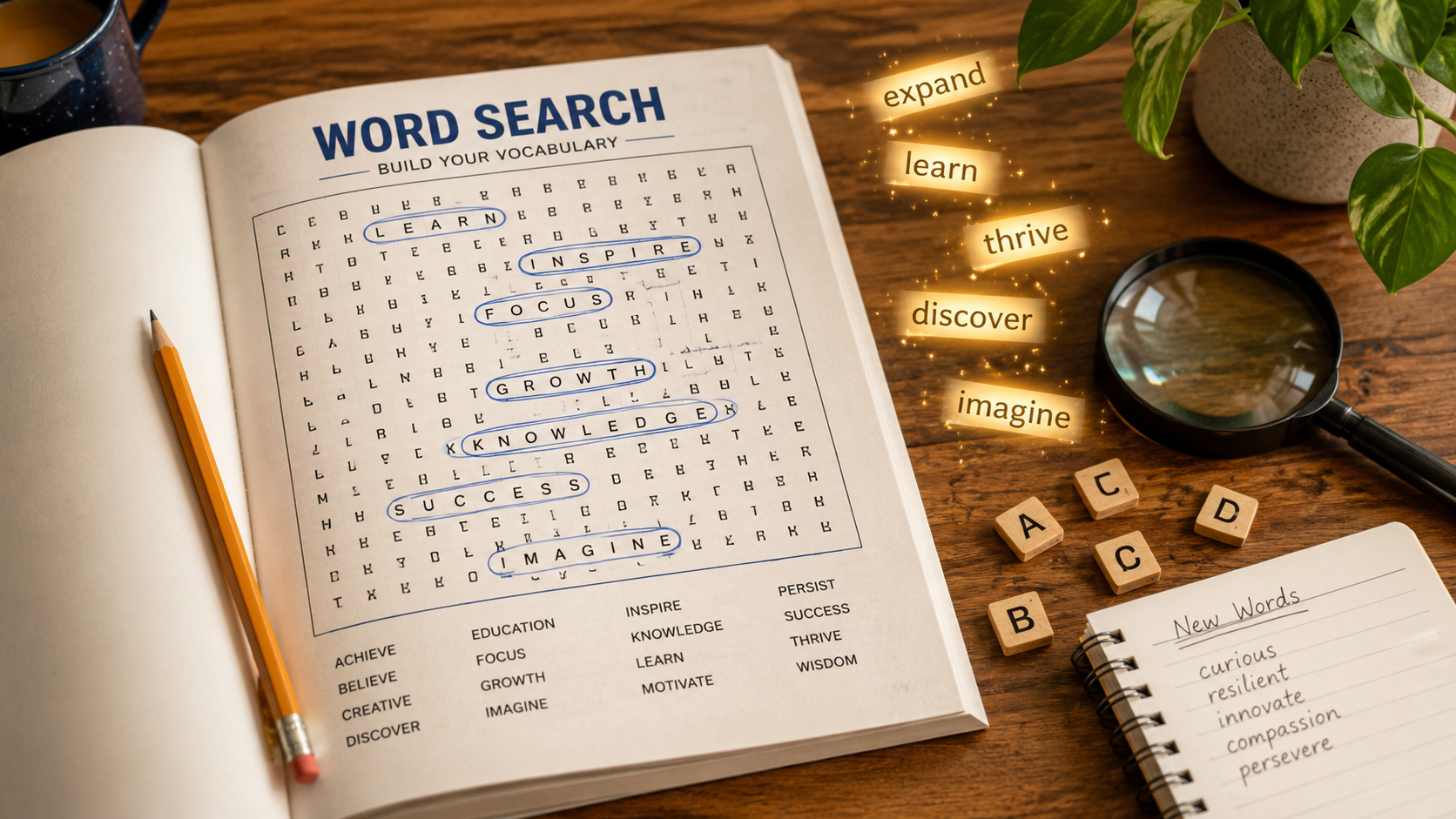

Word search puzzles are often seen as a simple and relaxing activity, but they can do more than just help pass the time. For many adults, seniors, students, and puzzle lovers, word searches can also be a fun way to build vocabulary and strengthen word recognition skills.
Unlike flashcards or memorization exercises, word searches make learning feel enjoyable. You are not studying a list of words in the traditional sense. You are actively searching, scanning, recognizing, and repeating words in a way that keeps your brain engaged.
So how exactly do word searches help improve vocabulary? Let’s take a closer look.
Word Searches Help You Recognize Words Faster
One of the biggest vocabulary benefits of word search puzzles is repeated word exposure.
When you look at the word list, then search for those same words in the puzzle grid, your brain sees each word multiple times. This repeated exposure helps make words more familiar.
The more familiar a word becomes, the easier it is to recognize later.
This can be helpful for:
Students learning new vocabulary
Adults who enjoy word games
Seniors who want screen-free mental activity
Anyone trying to improve focus and word recognition
Even when you already know the words, seeing them repeatedly can help reinforce spelling and familiarity.
Word Searches Strengthen Spelling Skills
To find a word in a puzzle, you have to pay close attention to every letter.
For example, if you are searching for the word “adventure,” you need to notice the order of each letter:
A-D-V-E-N-T-U-R-E
That process naturally reinforces spelling. You are not just reading the word quickly. You are examining it carefully letter by letter.
This helps build awareness of:
Letter order
Common spelling patterns
Word structure
Prefixes and suffixes
Similar-looking words
Over time, this can support stronger spelling confidence.
Themed Word Searches Introduce New Words
Themed word search puzzles are especially useful for vocabulary building.
A puzzle about nature might include words like:
Forest
Meadow
Evergreen
Wildlife
Habitat
A puzzle about travel might include:
Landmark
Passport
Journey
Destination
Itinerary
A puzzle about history might include:
Heritage
Artifact
Pioneer
Timeline
Monument
When words are grouped by theme, they become easier to understand and remember. The theme gives context, helping players connect new words to a specific topic.
That connection makes vocabulary learning feel more natural.
Word Searches Encourage Curiosity
Sometimes a word appears in a puzzle that the player does not fully recognize.
Instead of skipping it, many people become curious.
They may ask:
What does this word mean?
Have I seen this word before?
How is it pronounced?
How does it relate to the puzzle theme?
That moment of curiosity is valuable. It encourages learning without pressure.
A simple word search can lead someone to look up a new word, ask a question, or make a connection to something they already know.
Word Searches Improve Visual Scanning
Vocabulary is not only about knowing definitions. It is also about recognizing words quickly and accurately.
Word searches train the eyes and brain to scan letter patterns.
Players search for:
Beginning letters
Ending letters
Repeated letter combinations
Word shapes
Familiar spelling patterns
This kind of visual scanning helps strengthen word recognition. The faster someone recognizes familiar word patterns, the easier reading and vocabulary use can become.
Word Searches Help With Memory
When solving a word search, players often glance at the word list, then look back at the puzzle grid and try to remember what they are searching for.
This uses short-term memory.
The player may think:
“I’m looking for ‘sunshine.’ It starts with S and has two Ns.”
That process encourages the brain to hold and recall word information while searching.
For adults and seniors, this can be a helpful and enjoyable way to stay mentally engaged.
Word Searches Make Learning Feel Relaxing
One reason word searches are so effective is that they do not feel stressful.
There are no complicated instructions. There is no time limit. There is no pressure to answer clues like in some other word puzzles.
Instead, the activity feels calm and rewarding.
This makes word searches a great option for people who want to learn or stay mentally active without feeling overwhelmed.
They can be enjoyed:
With morning coffee
During quiet time
While traveling
Before bed
In classrooms
At senior centers
In assisted living activity programs
Because the activity is relaxing, people are more likely to stick with it.
Word Searches Build Confidence
Finding a word in a puzzle gives an immediate sense of success.
Each circled word feels like a small victory.
That sense of progress can build confidence, especially for people who may feel intimidated by more difficult word games.
For example, crossword puzzles often require clues, definitions, and outside knowledge. Word searches are more accessible because the words are already provided.
This makes them encouraging for:
Beginners
Seniors
Students
Casual puzzle fans
People returning to word games after a long break
Confidence matters because people are more likely to continue learning when they feel successful.
Word Searches Support Focus and Attention
To complete a word search, players need to concentrate.
They must scan carefully, ignore distractions, and keep track of which words they have already found.
This focus supports vocabulary growth because attention helps words stick.
Instead of passively reading a word list, the player is actively interacting with each word.
That active engagement makes the experience more memorable.
Large-Print Word Searches Make Vocabulary Practice Easier
Large-print word search books can be especially helpful for adults and seniors.
Bigger letters make puzzles easier to read and more comfortable to solve. This allows players to focus on the words themselves instead of struggling with small print.
Large-print puzzles may help reduce eye strain and make the activity more enjoyable for longer periods of time.
For seniors, large-print word searches offer a comfortable way to enjoy vocabulary-building, mental stimulation, and screen-free entertainment.
Word Searches Are Great for All Ages
One of the best things about word search puzzles is that they work for many different age groups and skill levels.
Children can use them to learn spelling and new vocabulary.
Adults can enjoy them as a relaxing mental break.
Seniors can use them as part of a daily brain game routine.
Because word searches can be created around almost any topic, there is always something new to learn.
Popular vocabulary-building themes include:
Animals
Travel
Nature
Food
Music
History
Science
Holidays
Decades
Hobbies
Famous places
The more varied the themes, the more opportunities players have to discover and reinforce new words.
Final Thoughts
Word searches may look simple, but they can be a powerful tool for vocabulary development.
They help players recognize words faster, strengthen spelling, improve focus, support memory, and introduce new vocabulary in a relaxing and enjoyable way.
Because they are easy to start and satisfying to complete, word searches make learning feel less like work and more like fun.
Whether you are a student, adult, senior, teacher, activity director, or lifelong puzzle lover, word searches offer a simple and effective way to keep your mind active while building vocabulary one word at a time.
At Everstone Publishing Group, we create large-print word search and Sudoku puzzle books designed for adults and seniors who enjoy relaxing, screen-free entertainment and brain-boosting fun.
Classic Sudoku
© 2026 Everstone Publishing Group