
How Sudoku Improves Logical Thinking
Sudoku is more than a number puzzle. Discover how it helps improve logical thinking, focus, problem-solving, pattern recognition, and decision-making for adults and seniors.
7/23/20265 min read
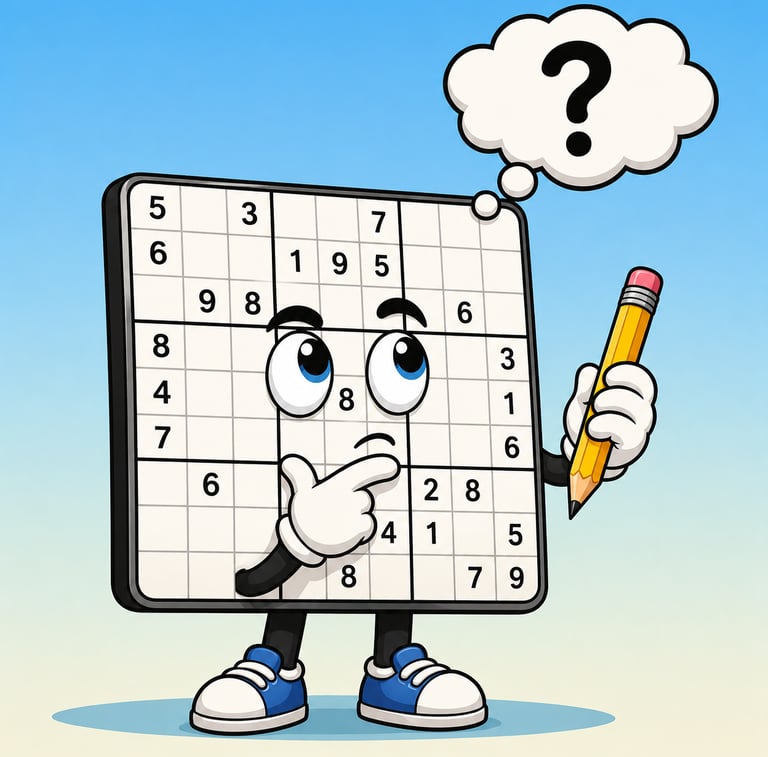
Sudoku is more than a simple number puzzle. It is a logic-based brain game that challenges players to think carefully, look for patterns, and make decisions based on reason instead of guessing.
Although Sudoku uses numbers, it is not really about math. You do not need to add, subtract, multiply, or divide. Instead, Sudoku is all about logical thinking.
Every number placed in the grid must follow a clear set of rules, and every correct move brings the puzzle closer to completion. That process makes Sudoku one of the most popular screen-free activities for adults, seniors, students, and puzzle lovers who want to keep their minds active.
So how exactly does Sudoku improve logical thinking? Let’s take a closer look.
What Is Logical Thinking?
Logical thinking is the ability to use reason, facts, and patterns to solve problems.
Instead of making random choices, logical thinkers ask questions such as:
What do I know?
What can I rule out?
What is the only possible answer?
What happens if I place this number here?
Does this choice follow the rules?
Sudoku strengthens this kind of thinking because every move must be supported by logic.
Sudoku Teaches You to Follow Rules
Every Sudoku puzzle follows the same basic rules:
Each row must contain the numbers 1 through 9.
Each column must contain the numbers 1 through 9.
Each 3×3 box must contain the numbers 1 through 9.
No number can repeat in a row, column, or box.
These rules create a structured problem-solving environment.
Players must think within the rules, which encourages discipline and careful decision-making. You cannot simply place a number because it “feels right.” You have to prove that it belongs there.
That habit of checking your work and following evidence is a key part of logical thinking.
Sudoku Helps You Eliminate Possibilities
One of the most important Sudoku skills is elimination.
When solving a puzzle, you often figure out what a square cannot be before you know what it must be.
For example, if a row already contains 1, 3, 5, 6, and 9, those numbers cannot go in the empty squares of that row. If a column or box removes even more options, eventually only one number may remain.
This process teaches the brain to narrow down choices step by step.
Instead of guessing, Sudoku encourages you to ask:
“What possibilities can I safely remove?”
That is logical thinking in action.
Sudoku Strengthens Pattern Recognition
Sudoku puzzles are filled with patterns.
Players learn to recognize:
Missing numbers in rows
Repeated number placements
Open spaces in 3×3 boxes
Candidate patterns
Number pairs
Logical connections between sections of the grid
The more Sudoku puzzles you solve, the better you become at noticing these patterns.
Pattern recognition is important because it helps the brain process information faster and more accurately. It also helps players spot opportunities that may not be obvious at first glance.
Sudoku Encourages Step-by-Step Problem Solving
Sudoku rewards patience.
Most puzzles cannot be solved all at once. Instead, they are completed one logical step at a time.
You may begin by finding one easy number. That number helps reveal another number. Then another. Slowly, the puzzle begins to open up.
This step-by-step process teaches an important lesson:
Big problems become easier when they are broken into smaller parts.
That same type of thinking can be useful in everyday life, school, work, and decision-making.
Sudoku Reduces Guessing
Guessing is one of the most common mistakes Sudoku players make.
While a guess might seem helpful in the moment, one wrong number can throw off the entire puzzle. That is why good Sudoku solving depends on proof.
Before placing a number, players should ask:
Does this number fit the row?
Does it fit the column?
Does it fit the 3×3 box?
Is there another possible answer?
Can I explain why this number belongs here?
This habit trains the brain to pause, analyze, and make thoughtful decisions.
Over time, Sudoku helps players become more comfortable relying on logic instead of impulse.
Sudoku Builds Focus and Concentration
Logical thinking requires focus.
When solving Sudoku, players must pay attention to multiple parts of the grid at the same time. A number in one box may affect a row across the puzzle. A placement in one corner may help solve another section later.
This requires concentration and attention to detail.
Sudoku helps players practice staying focused on a task, tracking information, and avoiding careless mistakes.
For adults and seniors, this can make Sudoku a relaxing but mentally engaging activity.
Sudoku Improves Decision-Making
Every Sudoku puzzle is full of decisions.
Where should you look next?
Which number should you scan for?
Which square has the fewest possibilities?
Should you work on a row, column, or box?
These small decisions help strengthen problem-solving skills.
The player learns to make choices based on available information, not random guesses. This supports stronger decision-making because the brain practices comparing options and choosing the most logical next step.
Sudoku Teaches Cause and Effect
In Sudoku, every number affects the rest of the puzzle.
Placing a 7 in one square means that 7 can no longer appear in the same row, column, or box. That single move changes the possibilities around it.
This teaches cause and effect.
Players begin to understand how one decision can create new opportunities or block certain choices. That kind of connected thinking is a major part of logic and problem-solving.
Sudoku Encourages Patience and Persistence
Some puzzles are easy. Others take time.
When a Sudoku puzzle becomes challenging, players must slow down and keep looking for logical openings.
This helps build patience and persistence.
Instead of giving up immediately, Sudoku encourages players to:
Recheck the grid
Look at a different section
Try another number
Review pencil marks
Search for hidden singles
Return to difficult areas later
This teaches that difficult problems can often be solved with steady effort and clear thinking.
Sudoku Supports Memory Skills
Sudoku also uses short-term memory.
Players often need to remember which numbers are missing, which candidates are possible, and which areas of the puzzle are close to being solved.
Even when using pencil marks, the brain is still organizing and reviewing information.
This supports mental engagement and helps players practice holding details in mind while solving a larger problem.
Sudoku Is a Screen-Free Brain Exercise
One of the best things about Sudoku is that it provides mental stimulation without needing a screen.
A Sudoku puzzle book and a pencil are all you need.
That makes Sudoku perfect for:
Morning coffee
Travel
Waiting rooms
Quiet evenings
Senior centers
Assisted living activities
Adult day programs
Porch or patio time
Screen-free breaks
For adults and seniors, Sudoku can become part of a healthy daily routine that keeps the mind active in a relaxing way.
Why Large-Print Sudoku Helps
Large-print Sudoku books are especially helpful for adults and seniors because they make the grid easier to read.
Clear numbers and larger squares can reduce eye strain and make puzzle solving more comfortable.
When the layout is easy to see, players can focus more on logic, strategy, and solving instead of struggling with small print.
This makes large-print Sudoku a great choice for seniors, beginners, and anyone who enjoys a more comfortable puzzle experience.
Tips for Using Sudoku to Build Logical Thinking
If you want to get the most benefit from Sudoku, try these simple tips:
Start with easy puzzles and build confidence.
Avoid guessing whenever possible.
Use pencil marks for possible numbers.
Focus on one row, column, or box at a time.
Look for numbers that appear frequently.
Double-check every placement.
Take breaks when you feel stuck.
Move to harder puzzles as your skills improve.
The goal is not to solve as fast as possible. The goal is to think clearly and enjoy the process.
Final Thoughts
Sudoku improves logical thinking by teaching players to follow rules, eliminate possibilities, recognize patterns, solve problems step by step, and make decisions based on evidence.
It is simple to learn, but it continues to challenge the brain in rewarding ways.
Whether you are a beginner, an experienced puzzle solver, an adult looking for screen-free entertainment, or a senior wanting a relaxing brain game, Sudoku offers a fun and meaningful way to keep your mind active.
Every puzzle is a chance to practice patience, focus, and logical thinking one number at a time.
At Everstone Publishing Group, we create large-print Sudoku and word search puzzle books designed for adults and seniors who enjoy relaxing, screen-free entertainment and brain-boosting fun.
© 2026 Everstone Publishing Group